24th March 2026
 https://www.eclipsehr.uk/wp-content/uploads/2026/03/pexels-startup-stock-photos-7374-1-500x333.jpg
workplace investigation process
https://www.eclipsehr.uk/wp-content/uploads/2026/03/pexels-startup-stock-photos-7374-1-500x333.jpg
workplace investigation process
The Workplace Investigation Process
Read more



by Rebecca Lister |
Article Summary
Major changes are taking place to UK employment law and schools must act now. This guide outlines key reforms from 2025 to 2027, what they mean for school HR teams, and the steps you should take to stay compliant and staff-supportive.
Eclipse HR reviews all recent employment law updates so we can provide advice on strategic actions. Prepare your school or MAT for these legal changes today. Book a compliance consultation with Eclipse HR to review your contracts, policies, and leave processes as the new reforms take effect.
The Employment Rights Bill has promised significant reform to the employment legal landscape and has dominated conversations ever since it was first announced as part of the Labour government’s election manifesto.
With the Bill now finalised, it is clear the changes will have a huge impact on the UK employment law landscape.
With changes from introduction of day one rights of unfair dismissal to banning of zero hours contracts, the Bill’s impact will be immense.
But what do the changes mean for schools and Multi-Academy Trusts? Read on as we explore some of the key changes and reflect on how they may affect you and your school or college.
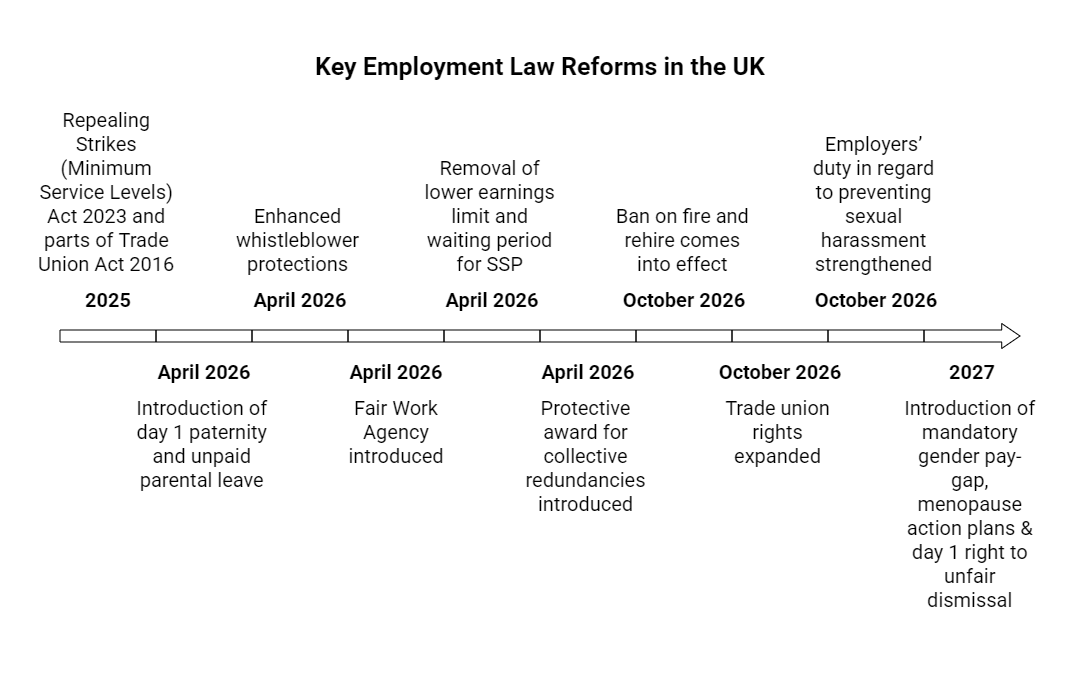
When talking about workplace compliance in respect of the Employment Rights Bill, day 1 unfair dismissal rights is often the first thing that comes to mind.
As a key manifesto commitment, the proposal attracted significant debate that was welcomed by some as a major step forward for employee rights, yet viewed by many employers as a potential risk to recruitment and workforce management.
After extensive negotiation between the House of Commons and the House of Lords, the proposed day one unfair dismissal rights were ultimately dropped in favour of a six‑month qualifying period.
This revision represents a pragmatic compromise, balancing enhanced employee protection with the need for business confidence and operational flexibility.
Extending unfair dismissal rights from the outset had raised concerns about an increase in early-stage tribunal claims and the impact this could have on employers’ willingness to hire, particularly among small businesses and those relying on short‑term contracts.
The introduction of a defined six‑month “breathing space” gives organisations the opportunity to conduct meaningful probationary assessments, address performance or conduct concerns, and conclude unsuitable employment relationships without the immediate risk of unfair dismissal claims.
By enshrining this qualifying period in legislation, the law delivers greater certainty for both employers and employees, while reinforcing the importance of having a clearly defined probation process in place.
Ensuring there is consistency within your approach to probationary periods and training line managers on what they should and shouldn’t be doing can go a long way in ensuring you are staying on top of the changes.
Additionally, now is a good time to ensure you have rigorous recruitment processes in place, to ensure the most suitable candidates are appointed to the role to mitigate risk of legal challenges.
Currently, Statutory Sick Pay applies to all employees and comes into effect on the fourth day of absence. To be eligible for SSP employees must earn above the Lower Earnings Limit – currently £125 per week.
The Employment Rights Bill removes the waiting period so that statutory sick pay must be paid from day one of sickness (rather than day four) and removes the lower earnings threshold so that lower earners, such as part-time teaching assistants, lunchtime supervisors, and exam invigilators will qualify for statutory sick pay.
The rate of SSP will also increase providing greater financial security for school employees during periods of illness.
Schools and colleges will see major changes to family-friendly employment rights under the Employment Rights Bill. From April 2026, staff will have access to key entitlements from day one of employment; including paternity leave, unpaid parental leave, parental bereavement leave, shared parental leave, and carers’ leave.
Importantly, employees will be able to take paternity leave even after shared parental leave, offering greater flexibility for teaching and support staff.
The Bill also introduces new protections against dismissal during pregnancy, maternity, and other family leave periods, as well as following a return to work. This is a significant shift for education HR teams managing staffing and safeguarding compliance.
In addition, the government has launched an 18-month review of the parental leave and pay system to modernise and simplify arrangements. This review will cover maternity, paternity, adoption, shared parental leave, and bereavement leave, assessing the system against four objectives:
The outcome could lead to further reforms impacting school workforce planning and budgeting.
From the 26th October 2024, the Worker Protection (Amendment of Equality Act 2010) Act 2023, came into force bringing in stronger protections against sexual harassment. Employers are now required to take reasonable steps to prevent sexual harassment proactively and systematically and be able to provide evidence of this.
With the law to be further strengthened under the Employment Rights Bill to include an obligation for employers to take “all reasonable steps”, it is important for schools to stay compliant.
Taking a strong stance in preventing sexual harassment is particularly important for the education sector. Putting the right policies and procedures in place ensures staff are safeguarded, expectations are clearly set out and a culture that supports and cares for its staff can grow.
Schools should ensure mandatory training is delivered to all staff on recognising and preventing harassment. Training should also be given on how to report sexual harassment and what actions to take if sexual harassment has been reported to you.
The updated Keeping Children Safe in Education (KCSIE) was released on 1st September 2025 and includes revised guidance on Relationships, Sex, and Health Education and revised guidance on gender questioning children.
Future iterations will reflect the progress into legislation of the Children’s Wellbeing and Schools Bill, the emerging further learnings from the work of the recent Casey Audit and subsequent inquiries, the Violence Against Women and Girls strategy and the interactions between these advances.
By the end of 2025, Academy Trusts will be expected to appoint a Sustainability Lead. This individual should work across departments, report to senior leadership and coordinate the Trust’s climate initiatives with the goal of progressing these initiatives and managing schemes that will better the school’s – or Trust’s – behaviour and approach toward decarbonization, Net Zero goals, and sustainability in general.
As part of the wider employment law changes introduced by the UK government, schools should also be aware of new entitlement provisions around flexible working, neonatal care leave, and enhanced dismissal protection. Updates on equal pay rights, race and disability discrimination, and sex discrimination legislation are also expected to influence HR policy and practice.
The reforms will likely have a knock-on effect on employment tribunal time limits, working hours regulations, and the calculation of holiday pay, national minimum wage, and national living wage. With such far-reaching reforms on the horizon, now is the ideal time to review employment contracts, pay structures, and flexible working arrangements.
Eclipse HR can provide tailored HR advice to help you navigate these evolving areas of compliance, ensuring your school or Multi Academy Trust remains fair, inclusive, and fully aligned with statutory obligations.
As an independent HR consultancy, we offer schools and MAT’s greater flexibility, responsiveness and specialised support tailored to their unique needs. This approach best places us to support schools and multi-academy trusts in this transition period.
At Eclipse HR, we provide specialist education HR consultancy services tailored to the education sector. Our team of HR specialists understands the complexities of HR in schools and MATs, offering expert advice on:
We stay up to date with all recent changes in employment legislation to ensure we are providing timely and compliant advice and support.
By partnering with Eclipse HR, schools can create a more supportive, compliant and successful educational environment. Contact us today to learn more about how we can support your school’s HR needs.
Please feel free to explore our website to learn more about the services we provide and how we can best support you and your School/Trust, or get in touch to talk to a member of our team today.
Author: Rebecca Lister
Rebecca supports the Eclipse HR team and our clients across a range of tasks. Rebecca has recently completed her Master’s degree in Advanced Legal Practice (MLaw) at the University of Kent and is now studying for her Solicitors Qualification Exams. Her academic focus, particularly in employment law, complements her practical experience and deepens her understanding of HR in action.
Disclaimer: Information and reference materials included within Eclipse HR Limited articles and blogs are provided free of charge and for reference purposes only. They are not intended as a substitute for legal advice, or professional or other advice in regards to specific circumstances. Whilst every effort is made to ensure the contents are correct on website publication, they should be considered for guidance purposes only.
https://www.eclipsehr.uk/wp-content/uploads/2026/03/pexels-startup-stock-photos-7374-1-500x333.jpg
workplace investigation process
Read more
 https://www.eclipsehr.uk/wp-content/uploads/2026/03/ChatGPT_Image_Mar_4__2026__02_55_28_PM-500x333.jpg
hr priorities
https://www.eclipsehr.uk/wp-content/uploads/2026/03/ChatGPT_Image_Mar_4__2026__02_55_28_PM-500x333.jpg
hr priorities
Read more
 https://www.eclipsehr.uk/wp-content/uploads/2025/06/pexels-pixabay-256491-1-500x333.jpg
Read more
How can we help?

Please get in touch using the form below.